Sever's Disease and How to Support Your Child's Feet

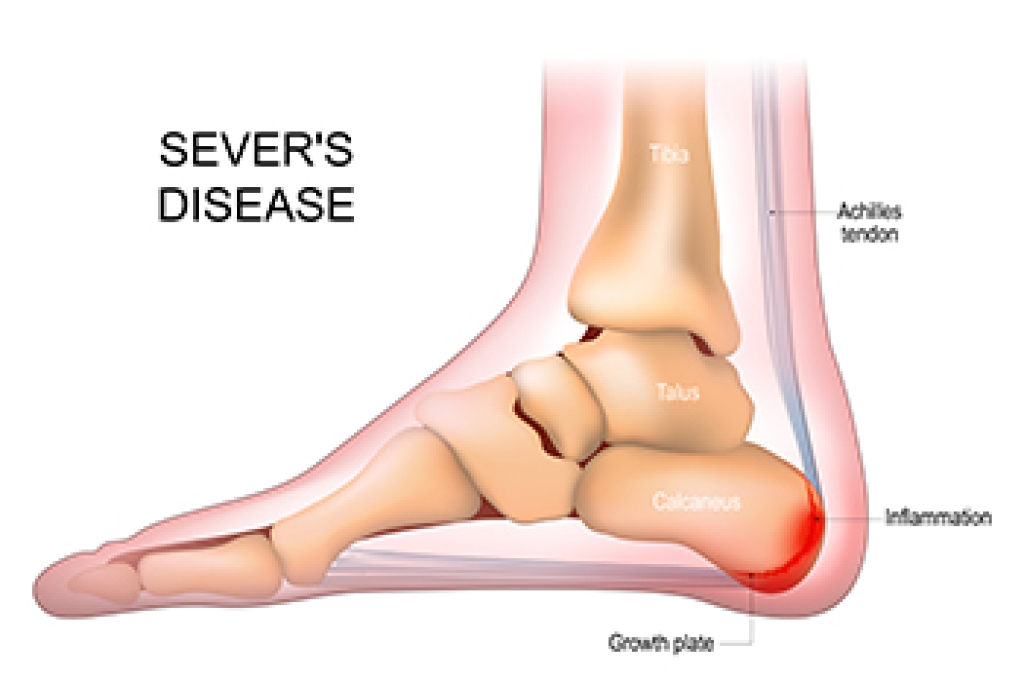
Sever’s disease is a condition that causes inflammation of the growth plate in the heel of children and adolescents, leading to heel pain and tenderness. It often occurs during periods of rapid growth when the bones, muscles, and tendons are developing at different rates. Children who are active in running, jumping, or sports are particularly at risk, as repetitive stress places additional strain on the heel. Diagnosis is typically based on a physical examination, medical history, and evaluation of activity patterns. A podiatrist can provide stretching exercises, footwear recommendations, supportive orthotics, and strategies to reduce pain and inflammation. If your active child has heel pain, it is suggested that you consult a podiatrist who can offer effective relief and management tips.

Sever's disease often occurs in children and teens. If your child is experiencing foot or ankle pain, see one of our podiatrists from APEX Foot & Ankle Center. Our doctors can treat your child’s foot and ankle needs.

Sever’s Disease

Sever’s disease is also known as calcaneal apophysitis, which is a medical condition that causes heel pain I none or both feet. The disease is known to affect children between the ages of 8 and 14.

Sever’s disease occurs when part of the child’s heel known as the growth plate (calcaneal epiphysis) is attached to the Achilles tendon. This area can suffer injury when the muscles and tendons of the growing foot do not keep pace with bone growth. Therefore, the constant pain which one experiences at the back of the heel will make the child unable to put any weight on the heel. The child is then forced to walk on their toes.

Symptoms

Acute pain – Pain associated with Sever’s disease is usually felt in the heel when the child engages in physical activity such as walking, jumping and or running.

Highly active – Children who are very active are among the most susceptible in experiencing Sever’s disease, because of the stress and tension placed on their feet.

If you have any questions, please feel free to contact our offices located in Fort Myers, Shellpoint, and Naples, FL . We offer the newest diagnostic and treatment technologies for all your foot care needs.

Read more about Sever's Disease

Why Live with Pain and Numbness in Your Feet?

Suffering from this type of pain? You may have the foot condition known as Morton's neuroma. Morton's neuroma may develop as a result of ill-fitting footwear and existing foot deformities. We can help.

Clubfoot and the Importance of Early Treatment

Clubfoot is a congenital condition in which a baby' s foot is twisted out of its normal position. The medical term, talipes, refers to this deformity, and one common form is talipes equinovarus, where the foot points downward and inward. In equinus, the foot is fixed in a downward position, while varus describes the inward turning of the heel. Causes may include genetic factors, abnormal fetal positioning, or neuromuscular conditions. Early diagnosis is essential to promote proper development and mobility. A podiatrist can evaluate the deformity, coordinate corrective treatment, and monitor progress throughout growth. If your child has been born with a clubfoot, it is strongly suggested that you include a podiatrist on your healthcare team to ensure healthy foot alignment and long-term function.

Congenital foot problems require immediate attention to avoid future complications. If you have any concerns, contact one of our podiatrists of APEX Foot & Ankle Center. Our doctors can provide the care you need to keep you pain-free and on your feet.

Congenital foot problems are deformities affecting the feet, toes, and/or ankles that children are born with. Some of these conditions have a genetic cause while others just happen. Some specific foot ailments that children may be born with include clubfeet, polydactyly/macrodactyly, and cleft foot. There are several other foot anomalies that can occur congenitally. What all of these conditions have in common is that a child may experience difficulty walking or performing everyday activities, as well as trouble finding footwear that fits their foot deformity. Some of these conditions are more serious than others. Consulting with a podiatrist as early as possible will help in properly diagnosing a child’s foot condition while getting the necessary treatment underway.

What are Causes of Congenital Foot Problem?

A congenital foot problem is one that happens to a child at birth. These conditions can be caused by a genetic predisposition, developmental or positional abnormalities during gestation, or with no known cause.

What are Symptoms of Congenital Foot Problems?

Symptoms vary by the congenital condition. Symptoms may consist of the following:

  • Clubfoot, where tendons are shortened, bones are shaped differently, and the Achilles tendon is tight, causing the foot to point in and down. It is also possible for the soles of the feet to face each other.
  • Polydactyly, which usually consists of a nubbin or small lump of tissue without a bone, a toe that is partially formed but has no joints, or an extra toe.
  • Vertical talus, where the talus bone forms in the wrong position causing other bones in the foot to line up improperly, the front of the foot to point up, and the bottom of the foot to stiffen, with no arch, and to curve out.
  • Tarsal coalition, when there is an abnormal connection of two or more bones in the foot leading to severe, rigid flatfoot.
  • Cleft foot, where there are missing toes, a V-shaped cleft, and other anatomical differences.
  • Macrodactyly, when the toes are abnormally large due to overgrowth of the underlying bone or soft tissue.

Treatment and Prevention

While there is nothing one can do to prevent congenital foot problems, raising awareness and receiving neonatal screenings are important. Early detection by taking your child to a podiatrist leads to the best outcome possible.

If you have any questions, please feel free to contact our offices located in Fort Myers, Shellpoint, and Naples, FL . We offer the newest diagnostic and treatment technologies for all your foot care needs.

Read more about Congenital Foot Problems

Connect With Us

Advanced Podiatric Procedures & Services in the Lee County, FL: Fort Myers, Fort Myers Beach, Cape Coral, Sanibel, Bonita Springs, Lehigh Acres, Estero, North Fort Myers, Matlacha, Alva, Bokeelia, Collier County, FL: Naples, Marco Island, Golden Gate, Immokalee, Everglades City, North Naples, East Naples, Vanderbilt Beach, Charlotte County, FL: Punta Gorda, Port Charlotte, Rotonda West areas